The Investment Model
The GSO Investment Model:
How Self-Funding Drives
Sustainable Conservation in Cambodia
Most NGOs fail within 3–5 years. GSO funds over 50% of operations internally — because aid ends, but investment compounds.
Quick Facts
50%+
Self-funded operations
17
Years of sustainability
3,600
Hectares protected
MoU #1388
Official Royal Government recognition
$0
Financial burden on families
The Problem
Why Most NGOs Fail — The Dependency Trap
How Donor Dependency Creates Fragile Programs
Across Cambodia, the same cycle repeats: an organization receives a grant, launches a project, photographs the ribbon cutting, and leaves. The project runs for the grant cycle. Then it stops. No revenue model. No sustainability plan. No one left to fix the broken parts. The $350 greenhouse becomes scrap. The solar panels go dead. The fish pond silts in and dries up.
What Happens When the Funding Stops
When the grant ends, the organization moves on. The community is left with equipment it didn't build, systems it can't maintain, and a gap where support used to be. One broken part — one part — and the entire investment becomes scrap, because no one stayed to fix it. This isn't an exception. It's the norm.
The 3–5 Year NGO Lifecycle Problem
Most NGOs in Cambodia operate on grant cycles of 3–5 years. They are structured to launch, not to sustain. The result:
- 37.5% of development projects in Cambodia are rated "likely" to fail — far above the global average of 26.7% (World Bank Independent Evaluation Group, Cambodia Country Assistance Evaluation 1999–2006)
- Programs designed for photo ops, not for the day after the ceremony
- Equipment sourced internationally, impossible to repair locally
- Organizations that leave the moment the grant ends
The dependency trap isn't a failure of intentions. It's a failure of design. Programs that rely on the next grant check are programs that can disappear with it.
Traditional Aid vs. GSO Investment Model
| Factor | Traditional Aid | GSO Investment Model |
|---|---|---|
| Funding source | External grants only | Volunteer program fees + enterprise revenue reinvested |
| When funding ends | Program collapses | Revenue continues from enterprises |
| Program design | Launch-focused | Revenue model built from day one |
| Family cost | Often hidden fees or co-payments | Zero financial burden |
| Organization presence | Visits during grant cycle | Based in the community long-term |
| Equipment sourcing | International, non-repairable | Local, locally repairable |
| Track record | 37.5% failure rate (Cambodia avg) | 17 years operating, no abandoned projects |
| Long-term outcome | Community returns to poverty | Pilot households report +41% income (Samlout, 3 years) |
The Solution
How GSO Funds Its Own Work
Internal Revenue Generation
GSO generates revenue from the work itself. Solar aquaculture produces catfish for market sale. Goat enterprises breed and sell livestock. Cow banks generate milk revenue. Eco-tourism employs local guides. Heavy equipment work builds roads and irrigation systems on contract. Each enterprise generates income that is reinvested into the programs that created it.
Community Revenue Generation as the Core Model
The revenue stays in the community. When a family sells goats to market, they keep the income. When eco-tourism generates guide employment, the wages go to local families. GSO builds the infrastructure. The community runs it. The income stays local.
Why Families Never Pay
Families do not pay for GSO programs. Not in fees, not in co-payments, not in hidden costs. Revenue from enterprises sustains operations. Families contribute time and participation. They keep the income their projects generate.
The Engine
How It Works: The Closed-Loop Revenue Cycle
Each program is designed so its output funds the next stage. Revenue doesn't just cover costs — it compounds.
The Closed-Loop Revenue Cycle
Solar Aquaculture
Cow Bank
Goat Enterprise
Eco-Tourism
THE GSO REVENUE ENGINE
[ Solar Aquaculture ] → Fish Sales → Irrigation → Crops → Household Income
[ Cow Bank ] → Milk Revenue → Calves → Next Family → Rotation
[ Goat Enterprise ] → Breeding Stock → Market Sales → Reinvestment
[ Eco-Tourism ] → Guide Employment → Forest Protection → More Tourism
↻ Every output funds the next input. No grant dependency. No program collapse.
Solar Aquaculture → Fish Sales → Irrigation → Crops → Income
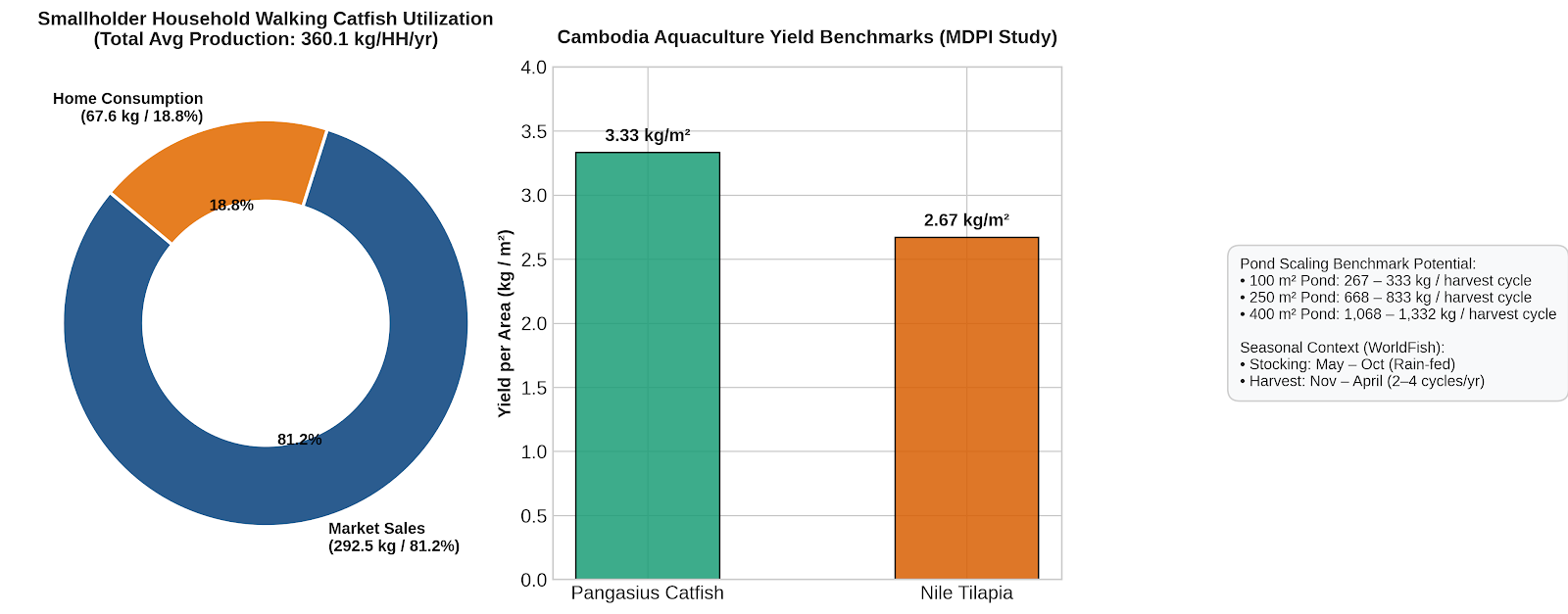
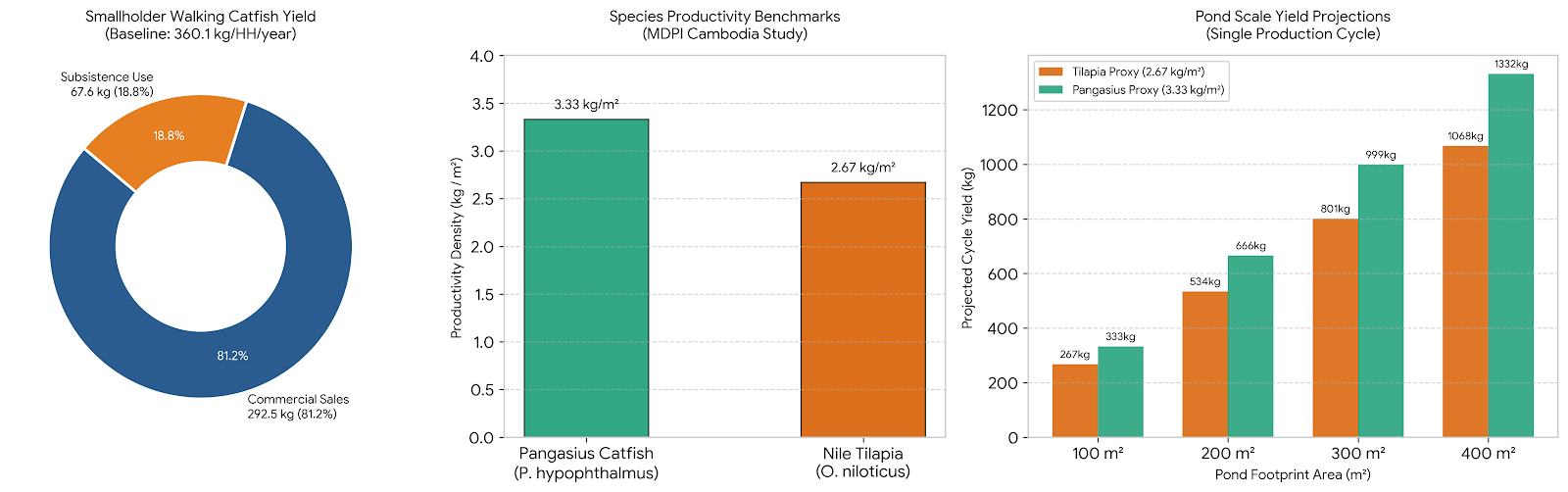
Solar-powered catfish systems produce fish for market sale. Nutrient-rich wastewater flows directly into planting beds. One system. Two harvests. Revenue from fish funds irrigation infrastructure that enables farmers to plant two rice crops a year instead of one. The income from doubled production sustains the aquaculture system — and the family.
| Metric | Budget / Benchmark | GSO Pilot Result |
|---|---|---|
| Tank cost | $3,500 (budget) | $2,300 (GSO pilot) |
| Survival rate | 68–76% (MDPI, 2018) | 90% (1-year pilot) |
| Yield per m² | 1.85–2.15 kg/m² (MDPI) | 26.8–53.7 kg/m² per cycle (exceeds 12–29x) |
| Revenue per cycle | — | $2,363–$6,075 (at $1.75–$2.25/kg) |
| Annual revenue | — | $4,725–$12,150 per tank (2 cycles) |
| Payback period | — | 0.3–0.7 years |
Sources: MDPI benchmark — Harvey, C., et al. (2018). Environments, 5(7), 76. DOI: 10.3390/environments5070076. GSO pilot — 1-year operational data, 90% survival rate, 3,000 fingerlings per 50.3 m² tank. Pending independent verification.
Cow Banks → Calves → Next Family → Rotation
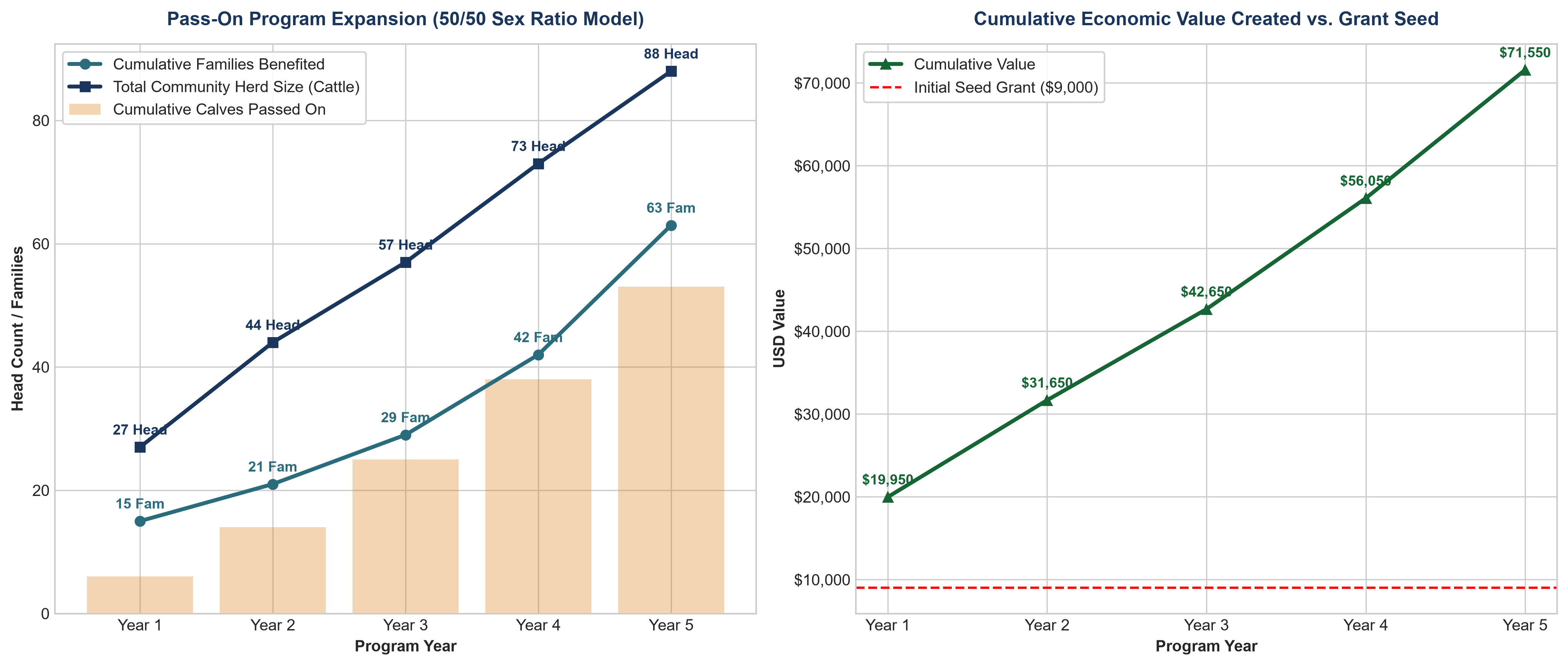
Fifteen female cows placed with women-led families. When a cow produces a calf, that calf becomes the next placement for a new family. Families may retain meat from culled or aged animals for household consumption or sell at market — generating income without relying on milk revenue. The asset is self-propagating. The program expands without requiring new external funding.
| Metric | 50/50 Sex Ratio Model | GSO Pilot Result |
|---|---|---|
| Seed investment | $9,000 (15 cows) | $400–$600 per cow |
| Families benefited (Year 1) | 15 families | 15 families (1-year pilot) |
| Families benefited (Year 5) | 63 families | 27 families (Year 2) |
| Cumulative calves passed on (Year 5) | 53 female calves | — |
| Cumulative economic value (Year 5) | $71,550 (7.9x multiplier) | — |
| Payback period | Self-sustaining from Year 2 | — |
Model assumes natural 50/50 sex ratio, first calf stays with recipient family, second female calf passed to next family. Economic value includes asset valuation, draft/tillage savings, and organic fertilizer. GSO pilot — 15 cows placed with women-led families in Arai Village, 2025–2026. Herd grew to 27 cows by Year 2. Pending independent verification.
Goat Enterprises → Breeding Stock → Community Sales → Reinvestment
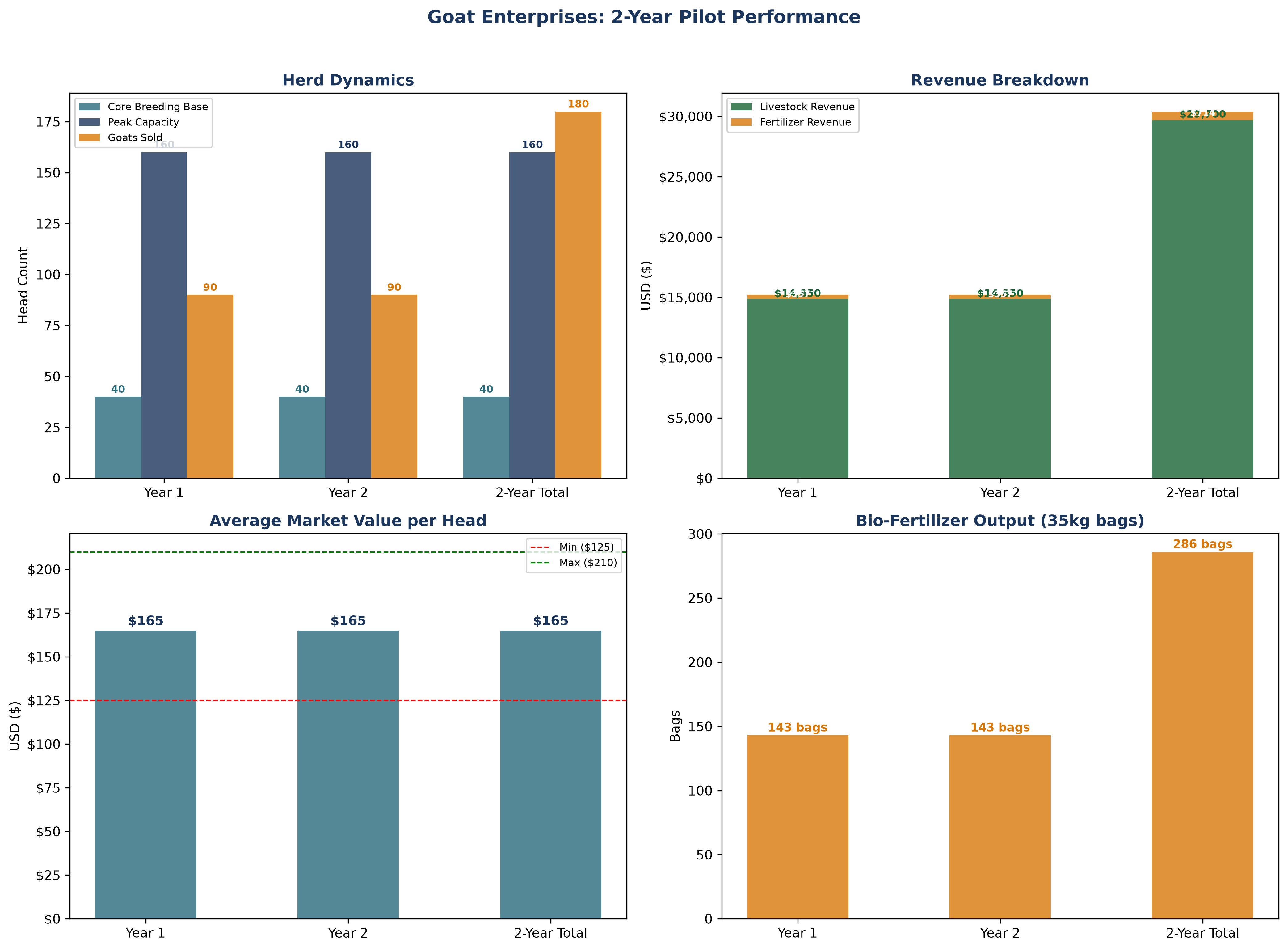
Herds grew from 40 to 130 animals, with 90 sold to market — a model replicated three consecutive years. Goats generate a second income stream: fertilizer bagged and sold to local gardeners and farmers. The model is replicable, with revenue from sales funding the next round of breeding stock.
| Metric | Operational Model | GSO Pilot Result |
|---|---|---|
| Seed investment | 40-head breeding base | $150–$250 per goat |
| Peak herd capacity | 160 head | 130 head at peak |
| Goats sold per year | 90 head (25–30 kg @ $5–$7/kg) | 90 head per year |
| Annual livestock revenue | $11,250–$18,900 | ~$14,850 (avg $165/head) |
| Fertilizer output | 5 tons/year (143 bags @ $2.50) | $357/year |
| 2-year gross revenue | $22,500–$37,800 | ~$30,414 (incl. fertilizer) |
| Revenue allocation | Operations + reinvestment | Funds new community pilots |
Model assumes 40-head permanent breeding base, multi-birth cycles, 90 goats sold annually at 25–30 kg. Fertilizer revenue from manure packaged in 35 kg bags. GSO pilot — Battambang province, 2-year operational data. Replicated three consecutive years. Pending independent verification.
Eco-Tourism → Guide Employment → Forest Protection → More Tourism
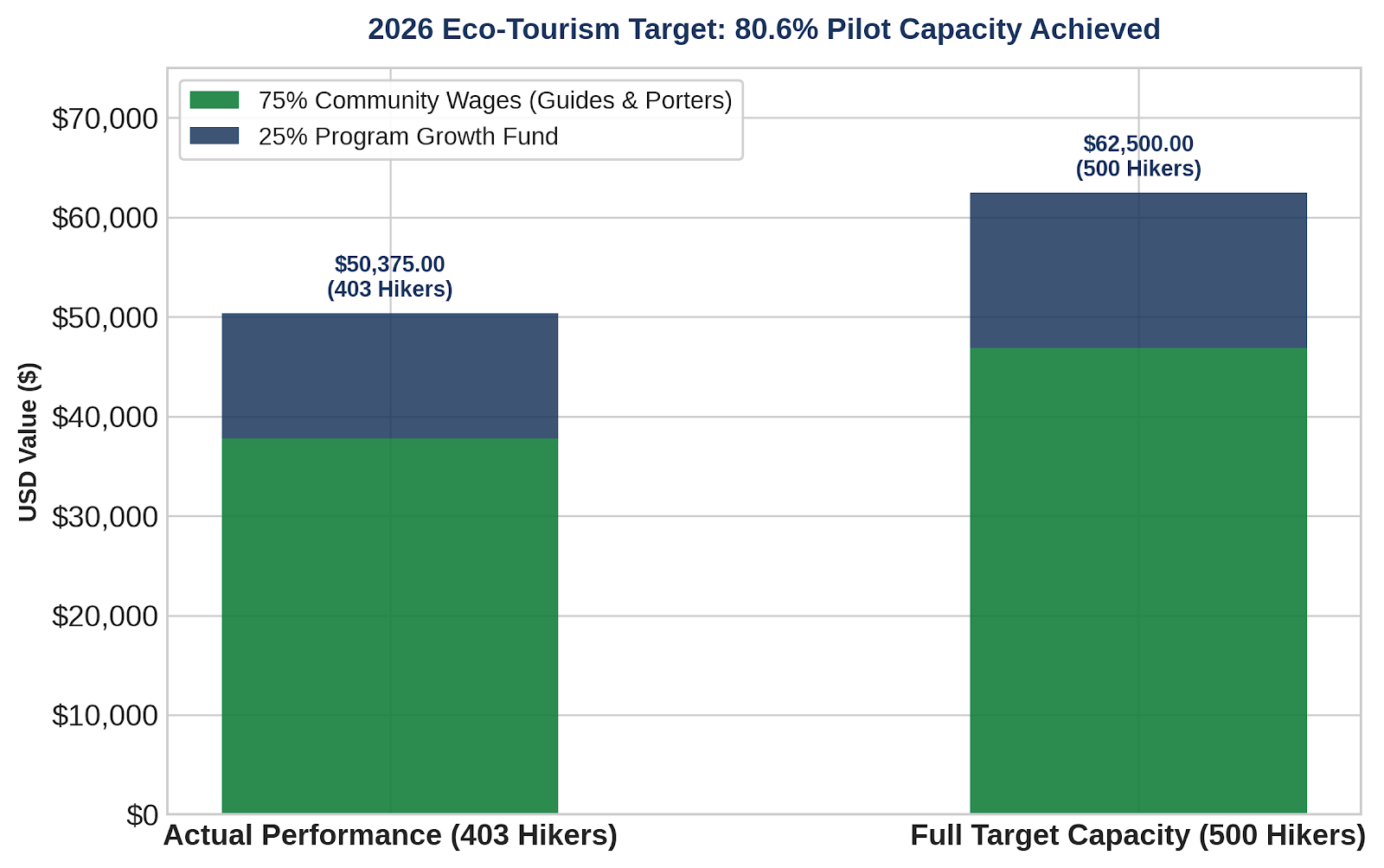
When tourists visit the Cardamom Mountains, they employ local guides. Those wages make forest protection more valuable than logging. The protected forest attracts more visitors. More visitors fund more protection. Fully self-funded through program activities and co-founder support — demonstrating that self-generated revenue can fund community infrastructure.
| Metric | Actual (403 Hikers) | Full Capacity (500 Hikers) |
|---|---|---|
| Capacity utilization | 80.6% | 100% |
| Gross revenue | $50,375 ($50/day, 2.5-day avg) | $62,500 |
| 75% community wages | $37,781 (guides, porters, host families) | $46,875 |
| 25% program growth fund | $12,594 | $15,625 |
| Upside gap | — | +$12,125 (97 more hikers) |
2026 pilot — Phnom Samkos Wildlife Sanctuary. 403 hikers hosted at $50/day, 2.5-day average duration. 75% of gross revenue paid directly to guides, porters, and host families. 25% retained for program growth. Pending independent verification.
Measurable Returns
The Numbers: Measurable Returns on Investment
+41%
Household Income Growth
+24%
Food Production Increase
-63%
Reported Chainsaw Activity Decrease
3,600
Hectares Under Protection
$152K
Enterprise Revenue (Pilot Projects)
Rural Cambodia baseline (CSES 2023): Average rural household income is ~$15.70/day (4.5 persons), or ~$3.49 per capita/day. The national poverty line sits at $2.70–$3.00 per person/day. Pilot participants typically start near or below this threshold. The +41% figure represents measured income increase across participating households in the Samlout pilot area over 3 years.
Income Baseline
What $5/Day Actually Means in Rural Cambodia
Household vs. Per-Capita
Official government data (CSES 2023) shows $5/day is accurate for per-person income in rural Cambodia — not total household income. A typical rural household (4–5 members) generates $12–$16/day total.
National avg household: ~$628/month ($20.93/day)
Rural household (~75%): ~$471/month ($15.70/day)
Per capita rural: ~$3.49/person/day
National poverty line: $2.70–$3.00/person/day
Primary Income Drivers
Agriculture & Subsistence
Crop farming (rice) and livestock — seasonal cash flow plus self-consumed produce
Off-Farm & Wage Labor
Local day labor in construction, agriculture, or small-scale trading
Remittances
Monthly transfers from family working in urban garment factories or abroad
How Each Intervention Stacks
GSO's model doesn't replace existing income — it adds layered revenue streams on top. A family starting at the $1,500/yr baseline ($4.11/day) can reach $3,620/yr ($9.92/day) with a full portfolio of 6 goats, 2 cows, and 1 fish tank — a 141% increase.
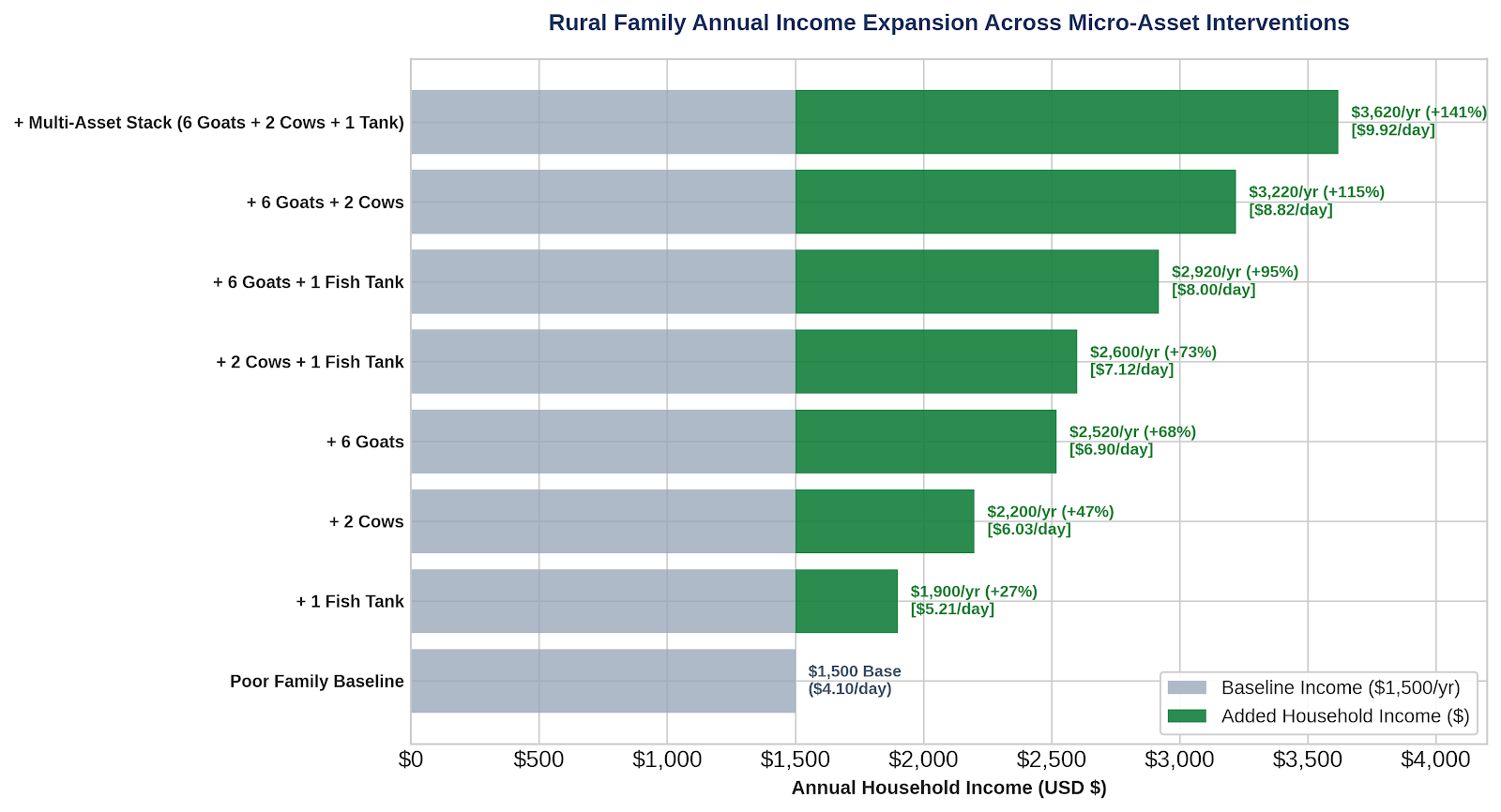
Baseline: $1,500/yr ($4.11/day) — typical for households near the national poverty line. Each intervention adds measured revenue: fish tank (+$400/yr), 2 cows (+$700/yr), 6 goats (+$1,020/yr). Multi-asset stack combines all three. GSO pilot data, pending independent verification.
For Donors & Grant Officers
Why This Matters for Donors and Grant Officers
Your Investment Generates Returns, Not Requests
When you fund GSO, you're not funding the next grant cycle. You're funding an enterprise that generates its own income. Your investment compounds. The revenue from solar aquaculture doesn't just cover costs — it funds irrigation, which funds crops, which funds household income. The cow placed with a family doesn't just produce milk — it produces the next calf for the next family. Your dollar doesn't just spend. It works.
Government Partnership as Validation (MoU #1388)
In 2025, GSO signed a Memorandum of Understanding with the Veal Veng District Leadership — formalizing GSO's role in community-based conservation and sustainable development. This isn't a token endorsement. It's institutional recognition from the Royal Government of Cambodia that GSO's model works. 17 years of on-the-ground results. Government validation. A track record that speaks for itself.
17 Years of Proven Sustainability
Most NGOs don't survive their first grant cycle. GSO has been operating since 2009 — through funding droughts, economic downturns, and global crises. When money was tight, we reached into our own pockets. When parts broke, we fixed them ourselves. Not because we had to. Because these are our neighbors, and you don't abandon your neighbors when a grant cycle ends.
Scalable Model for Other Communities
Pilot data across three enterprises shows promising results. Goats grew from 40 to 130 animals across three consecutive years. Cow banks placed 15 cows with women-led families. Solar aquaculture produced stable harvests. The training center model — community ownership, practice before ownership, locally sourced parts — is designed for replication in communities facing similar challenges. Your investment doesn't just help one village. It builds the blueprint for the next one.
Get Involved
How to Support the Investment Model
Fund a Specific Project
Fund solar aquaculture systems, cow placements, goat enterprises, or irrigation infrastructure. Every dollar goes directly to the enterprise — not overhead.
View ProjectsPartner With GSO
Sponsor a training center, underwrite a women's livestock program, or bring your organization's expertise to our team. Partnerships that scale impact.
Contact UsVolunteer Your Skills
Bring your skills to Cambodia. Work alongside communities. Build what matters. Stay long enough to see it work.
VolunteerRelated Pages
- Our Work — See the programs that the investment model sustains
- Our Story — How GSO evolved from education to self-funded conservation
- Projects — Fund specific enterprises and see exactly where your money goes
- Volunteering — Bring your skills to communities that need them
- SDG Compliance — How GSO aligns with the UN Sustainable Development Goals
- Eco-Tourism — The tourism arm of the revenue cycle
Frequently Asked Questions
The Investment Model — FAQ
How does GSO fund over 50% of its operations without relying on grants? +
GSO generates revenue through community enterprises: solar aquaculture fish sales, goat breeding and market sales, cow bank milk revenue, eco-tourism guide employment, and heavy equipment contract work. These activities produce recurring income that sustains programs without external grants.
What is the 3–5 year NGO lifecycle problem? +
Most NGOs in Cambodia operate on short grant cycles of 3–5 years. When funding ends, programs collapse because they were never designed to sustain themselves. GSO avoids this by building revenue-generating enterprises into every program from the start.
Do families ever have to pay for GSO programs? +
No. GSO programs are designed so families bear zero financial burden. Revenue from enterprises — not families — sustains operations. Families contribute time and participation, and they keep the income their projects generate.
What is the closed-loop revenue cycle? +
Each program is designed so its output funds the next stage. Solar aquaculture produces fish for sale; revenue funds irrigation; irrigation grows crops; crops generate household income. Cow banks produce calves for the next family; goat enterprises generate market sales; eco-tourism funds forest protection, which attracts more tourists.
What measurable results has the investment model produced? +
The model has delivered a 41% increase in household income, 24% increase in food production, a reported 63% decrease in audible chainsaw activity, 3,600 hectares under community monitoring, and over 50% self-funded operations.
How is GSO different from traditional aid organizations? +
Traditional NGOs rely on donor grants and leave when funding ends. GSO invests in community enterprises that generate their own revenue. Programs are designed to be self-sustaining from day one, and GSO staff live in the communities they serve.
Our Next Chapter
Scaling What Already Works
For 17 years, we have independently funded our mission, building a proven, scalable model grounded in long-term commitment. But the challenges facing our community today are larger than any single organization's balance sheet. To expand our reach and tackle these issues at the scale they demand, we are actively inviting strategic partners and grantmakers to join us for our next chapter.
Invest in Conservation That Compounds
Your donation doesn't ride in a convoy. It walks next door. Every project is documented. Every dollar is tracked.